Emerging Leaders Program
ELP is designed for academic and administrative professionals to gain a greater appreciation of the Academy and build the skillset and mindset to lead campus initiatives and advance to more senior leadership roles. Participants graduate with skills, connections, and support necessary to navigate the transition to higher administrative roles.
Get notified.
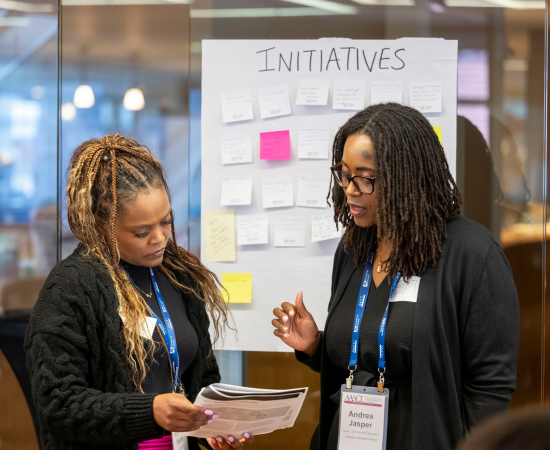
ELP is designed to prepare the next generation of higher education leaders to be effective, compassionate, resilient, accountable and courageous to help all students reach their goals.
ELP provides the opportunity for participants to assess their individual leadership style and strengths; develop or enhance a leadership philosophy and to apply the skills learned in the instructional portion of the program to a project/initiative on their home campus over the course of the academic year.
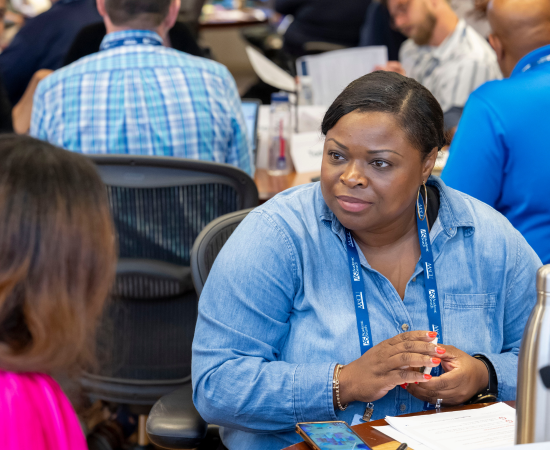
Who Should Participate
- Mid to senior level academic and administrative professionals serving at regional public universities who are exploring opportunities to advance to higher-level administrative positions.
How You’ll Benefit
- Develop a systems-level view of how academic institutions function—from governance and finance to student affairs and faculty development—helping to influence institutional priorities and navigate complex organizational dynamics
- Build the capacity to lead change initiatives with clarity, empathy, and resilience
- Gain a trusted circle of colleagues who understand your challenges and can offer insight, encouragement, and collaboration
- Showcase your leadership in action through a campus project—from vision-setting to execution and reflection
What to Expect
- Discussions of the evolving leadership competencies needed to lead in today’s complex and turbulent times
- Tailored to the distinctive needs of mid-career academic or administrative professionals exploring leadership roles at regional public universities
- Opportunity for real-time application and impact of tools and trainings via a campus project
- Strong relational component—commitment to create and support trust, encourage peer-to-peer learning, confidentiality, and safety among the cohort
- Gain a comprehensive understanding of the various aspects of the academe and how they relate to each other
- Learn and apply the fundamentals of project management
- Develop critical skills for leading transformational institutional change
- Strengthen communication skills
- Enhance management and leadership skills; specifically leading up, down and sideways
- Build a strong and supportive network of peers and mentors
- Demonstrate leadership skills by leading an on-campus project or initiative
- University governance, structure and systems to support students
- Budgeting, finance and administration
- Effective communications
- Navigating and leading change
- Leadership case studies in crisis management
- Managing staff and faculty
- Navigating the search process
- National trends in higher education
- Regional Public Universities – our unique role
- Project management
Participants will lead a project or initiative at their home campuses over the course of the academic year, under the guidance of a designated advisor. The project will have an impact on the campus community and align with the participant’s professional goals. Examples of university projects include the following:
- Chairing or co-chairing a division, university-wide committee, or task force that requires working with multiple constituencies
- Managing a project for a division or university strategic initiative
- Conducting a research project that investigates a challenge the university faces and provides an opportunity for the participant to influence campus decision-makers using data
Programming will be a blended experience, with in-person and virtual programming. In-person programming will not be livestreamed or otherwise recorded. 100% attendance and participation is expected. Virtual programming will take place on select Wednesdays and Fridays between 3 and 5 p.m. ET (exact dates TBD).
- An intensive in-person program at AASCU’s Washington, D.C. office (June 23–25, 2026)
- Up to 12 interactive 60-to 120-minute interactive virtual sessions (August–December 2026)
- A project or initiative the participant leads on their home campus
- Applications that are complete, including a nomination/endorsement from a president/chancellor or cabinet-level administrator, and submitted by the deadline will be considered.
- ELP faculty review applications and select a cohort that reflects AASCU institutions across the country
- Preference is given to applicants from AASCU member institutions and regional public universities.
- A complete application for ELP includes the following:
- Nomination or endorsement from the president/chancellor or cabinet-level administrator from your home institution
- Clear and concise summary of your personal and professional development goals
- Description of your campus project and how it supports your professional goals
- Commitment to 100% participation
2026 Registration Fees
- Participants from AASCU member institutions: $2,500
- Participants from non-member institutions: $3,500
- The registration fee covers program administration, meals during the in-person intensive, and all materials. Participants are responsible for their own travel and accommodation in Washington, D.C.
- Upon acceptance to ELP, participants must register no later than April 10, 2026
Scholarships
- Limited scholarships are available to accepted applicants from AASCU member institutions.
Cancellation Fees
- Cancellations received before May 1 are eligible for a refund, minus a 25% administrative fee.
- Cancellation requests received on or after May 1, 2026 are NOT eligible for a refund.
- If you need to cancel after May 1, please email leadershipdevelopment@aascu.org to explore if you are eligible for a deferral to a different iteration of ELP or receive a credit toward a different program.
Meet the 2025 ELP faculty.
ELP has convened an impressive faculty of current and former presidents, chancellors, cabinet-level administrators, and national subject matter experts. The faculty roster may change in 2026.
Eric
Algoe
Executive Vice President for Operations and Chief Financial Officer
Texas State University
Heidi M.
Anderson
President
University of Maryland Eastern Shore

Holly
Attenborough
Assistant Provost
University of Wisconsin-Platteville

Mary C.
Brackett
Senior Director
University of Virginia

Andy
Brantley
President and CEO
College and University Professional Association for Human Resources

Isaac
Brundage
Vice President of Student Affairs
California State University Chico

Amy
Díaz
Chief of Staff and Interim Vice Chancellor of External Affairs
Indiana University Northwest

Kristin G.
Esterberg
Chancellor
University of Washington Bothell
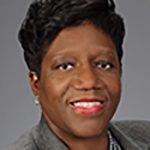
Marion R.
Fedrick
Executive VP and Chief of Staff
Georgia State University

Dan
Feely
Managing Partner
Transforming Solutions, Inc.
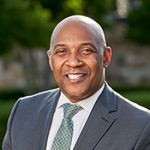
Bennie L.
Harris
Chancellor
University of South Carolina Upstate
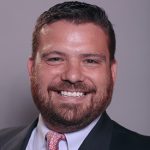
Shawn
Hartman
Chief Operating Officer
Academic Search

Mary E.
Kennard
Senior Consultant
Academic Search

Lynn
Mahoney
President
San Francisco State University (CA)
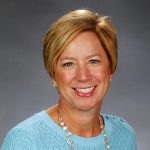
Kathleen
Scott
Vice President of Leadership Development and Partnerships
AASCU

Bey-Ling
Sha
Dean, College of Media and Communication
Texas Tech University

Ed
Venit
Managing Director
EAB

Charles L.
Welch
President and CEO
AASCU

Dannelle
Whiteside
Vice President for Legal Affairs and Organizational Strategy
Austin Peay State University (TN)
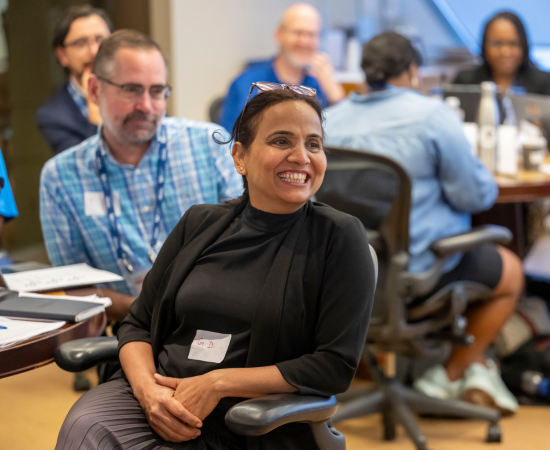
ELP connects, equips, and empowers the next generation of higher education leaders.
ELP has a high impact on the skillsets and mindsets of program participants and the curriculum effectively addresses top-of-mind issues for today’s emerging leaders at AASCU institutions.
The Numbers
93%
Percentage of 2023 cohort members who reported feeling connected to colleagues at peer institutions at the end of ELP.
4.63 out of 5
Average rating of content, presentation, and speaker quality for all 2023 ELP programming.
33%
Increase in feeling equipped with the knowledge and relationships needed to pursue career goals from the start to the end of the program (2023 cohort).
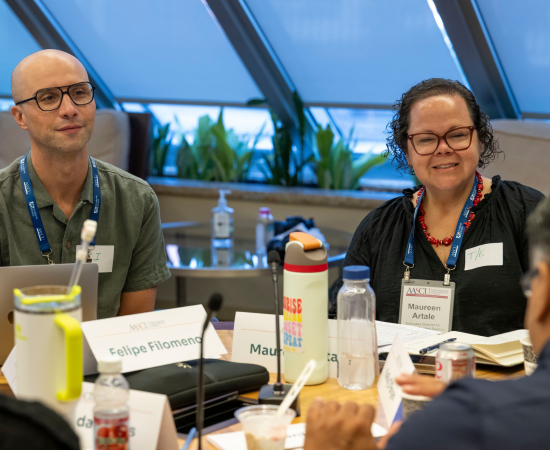
The Stories
“AASCU’s Emerging Leaders Program has been transformative in aligning my leadership aspirations with actionable goals. The program equipped me with essential skills to navigate university leadership roles, offering insights that directly resonate with my short-term goal of excelling in academic and administrative positions, and my long-term aspiration to advance in higher education leadership.”
“Due to my participation in the program, I am a more confident leader on-campus and in my community, and I have gained clarity on the path I wish to take as I progress in my career. Additionally, I gained a community of support that I can leverage for informal or formal academic, professional, and/or social support. I recommend this program to anyone working in higher education that have aspirations to ascend in leadership whether that be on the faculty or administrative side.”
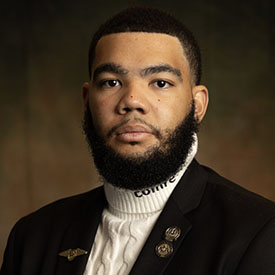
“The Emerging Leaders Program exceeded my expectations with its exceptional organization, timely relevance to the evolving landscape of higher education and social climate, and unwavering commitment to intentionality. The program’s faculty provided pragmatic and supportive guidance, fostering a rich environment for personal and professional growth. Due to my participation in the program, I am a more confident leader on-campus and in my community, and I have gained clarity on the path I wish to take as I progress in my career.”
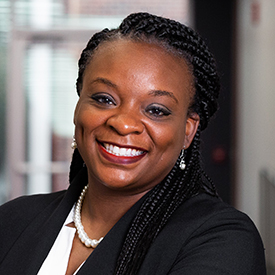
“The Emerging Leaders Program afforded me the opportunity to not only learn, but engage and network with leaders. This program is truly intentional with developing methods of success for future leaders. I thoroughly enjoyed and am grateful to be able to have this experience.”
Meet the 2025 Cohort

Maureen P.
Artale
Executive Director for Academic Student Support and University Registrar
State University of New York at Oneonta

El Hachemi
Bouali
Associate Professor of Geosciences
Nevada State University

Nichole J.
Brown
Director of the School of Education Clinical Practice and Partnerships Office and Director/Principal Investigator, Teacher Opportunity Corps (TOC II) Program
State University of New York at Oswego

Cornelius
Brownlee
Assistant Dean of Student Conduct and Community Standards
Lincoln University of Missouri

Kyle
Carrigan
Director of Concurrent Enrollment and Continuing Education
Central Washington University

Christina R.
Caul
Director of Student Success
Kentucky State University

Jason D.
Coleman
Associate Dean, College of Education, Health, and Human Sciences
University of Nebraska at Omaha
Todd C.
Couch
Associate Professor of Sociology, Co-Director of African and African American Studies
Francis Marion University (SC)

Gregory
Dam
Associate Vice Chancellor of Academic Affairs
Indiana University East

Felipe
Filomeno
Director of Global Studies and Associate Professor of Political Science
University of Maryland, Baltimore County

Logan J.
Fowler
Chief Communications & Marketing/State & Local Affairs Officer
Lewis-Clark State College (ID)

Barbara D.
Garrett
Chair and Professor
University of Northern Colorado

Siobahn
Grady
Founding Director, Institute for Artificial Intelligence and Emerging Research; Associate Professor of Information Science
North Carolina Central University

Brad
Hamel
Executive Director – Global Campus
Northern Michigan University

Rolanda
Harris
Director of Adult Continuing Education and Prior Learning Assessment
Delaware State University

Andrea D.
Jasper
Dean, School of Education
Georgia Gwinnett College
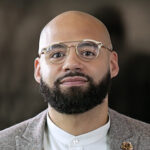
Drew
Johnson
Program Director The TRIO Ronald E. McNair Scholars Program
North Carolina Central University

Brandy
Johnston
Assistant Vice Chancellor for Finance/Treasurer
Arkansas State University Jonesboro

Dustin L.
Jones
Associate Dean
Sam Houston State University (TX)

Ellen
Koski
Assistant Director, Strategic Planning
Northern Michigan University

Michael
Kush
Associate Vice President of Student Affairs, Dean of Students
State University of New York at Oneonta

Karla J.
Leybold
Assistant Dean and Director, Quillen Honors Scholars Program
East Tennessee State University
Latisha
Marion
Associate Vice President Student Financial and Military Success
Texas Southern University

Carson
Medley
Assistant Dean, Director, Office of Prestigious Awards and Scholar Development
East Tennessee State University

Chantel
Merchen
Director-Office of Academic Success
Chadron State College (NE)

Clay
Motley
Dean, College of Arts & Sciences
Florida Gulf Coast University

Kelly
O’Bryan
Director of University College
Langston University (OK)

Latofia
Parker
Chair, Department of Consumer & Human Sciences; Director of UM Grainger Community Counseling & Wellness Clinic; Professor of Counselor Education
University of Montevallo (AL)

Kimberly C.
Riddick
Director, Student Leadership and Success
University of North Texas at Dallas

Rachna
Sadana
Chair and Professor, Department of Natural Sciences
University of Houston-Downtown (TX)

Priyank
Shah
Associate Vice Chancellor of Equity and Inclusion
Minnesota State Colleges and Universities

Satish K.
Sharma
Professor and Director, Antenna and Microwave Lab (AML)
San Diego State University (CA)

Timothy
St. John
Dean of Students
Fitchburg State University (MA)

Dillon S.
Tatum
Department Chair, Department of Political Science and Geography
Francis Marion University (SC)

Geoffrey L.
Wood
Chair, Behavioral Sciences Division; Associate Professor of Sociology; Director, Center for Applied Research (CFAR)
University of Pittsburgh at Greensburg (PA)

Crystal A.
Wymer-Lucero
Director of Alumni Relations
California State University, San Bernardino

Murat
Yaşar
Deputy to the President for Strategy, Planning, and Special Projects
State University of New York at Oswego
Recent Program News
Our Thought Partners



Applications for the 2026 ELP applications are closed.
Application Details
Application Requirements
- Early- to mid-career academic and administrative emerging leaders who are exploring opportunities to advance to higher-level administrative positions
- Brief description of the campus project/initiative you will lead under the guidance of a designated mentor
- Endorsement from a president/chancellor or cabinet-level administrator from your home institution
Important Dates
- The 2026 program will take place from June 2026 to December 2026
- Applications and endorsements for 2026 are due February 9, 2026
Have questions about the Emerging Leaders Program? Let us know.
"*" indicates required fields
